Introduction
Project Overview
ApplyIQ is an internal AestheTeQs AI and automation project built to explore how an end-to-end job search can be transformed from a repetitive manual process into an orchestrated automation pipeline.
The platform combines a user-facing application with job data collection, AI-assisted matching and CV tailoring, workflow automation, persistence, notifications, and application tracking.
Its automation architecture uses n8n dispatcher/worker workflows, allowing job-processing tasks to be separated and coordinated rather than running everything through a single monolithic workflow. Apify is used for data collection and Supabase provides persistence.
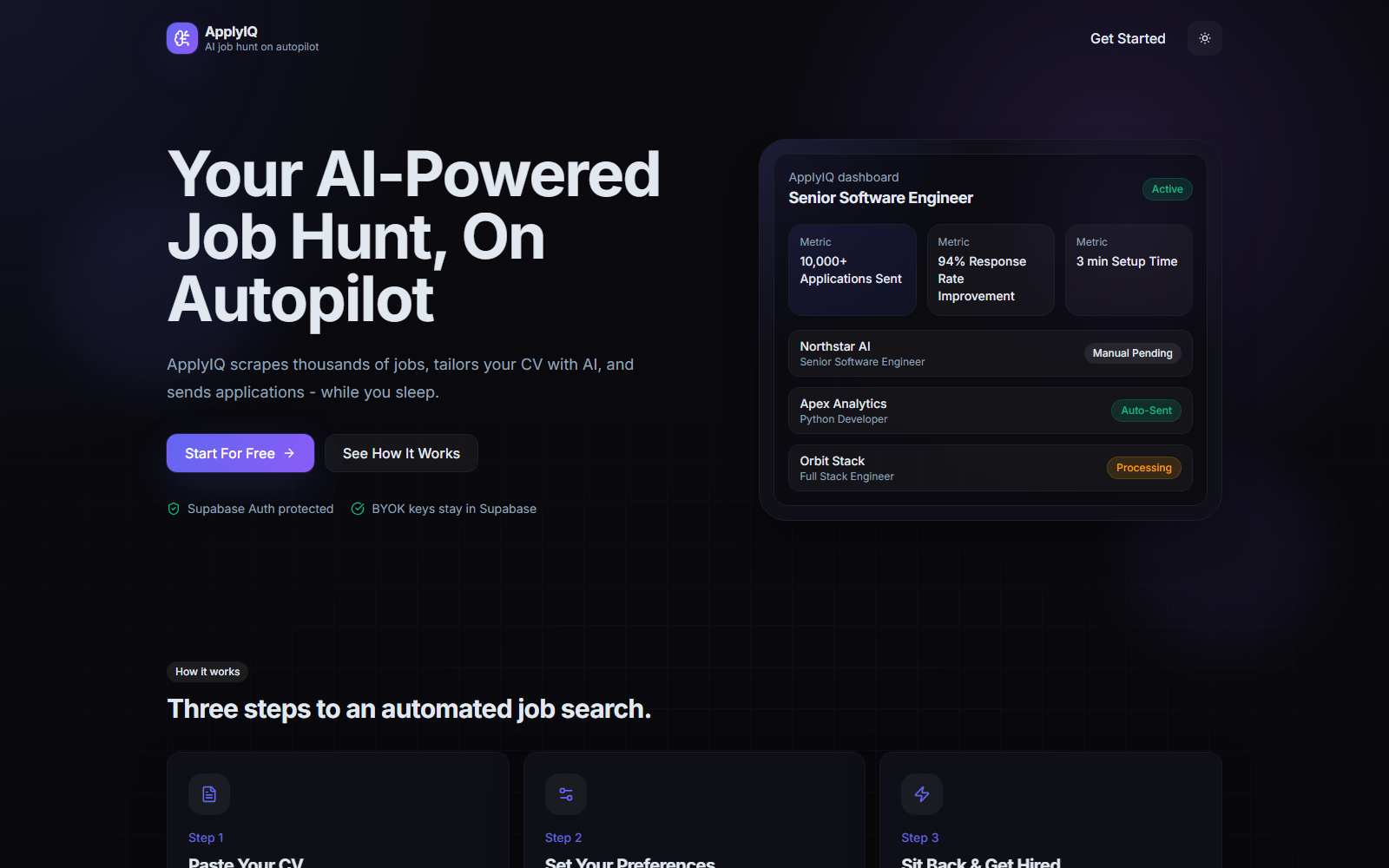
ApplyIQ's public application presents the workflow as three basic user steps: provide a master CV, define job preferences, and allow the automation system to process opportunities and prepare applications.
The project was created internally to develop practical skills across n8n automation, asynchronous workflow design, scraping, Supabase, AI document workflows, and SaaS-style job processing.
Mechanism
Project Description
The challenge
A serious job search contains many repetitive tasks:
Performing these tasks manually across dozens or hundreds of opportunities consumes significant time.
The solution
ApplyIQ turns the process into a structured pipeline.
Master CV + Preferences
           ↓
      Scheduled Search
           ↓
       Job Scraping
           ↓
       Job Ingestion
           ↓
    Matching / Analysis
           ↓
       CV Tailoring
           ↓
    Document Generation
           ↓
   Automation Decision
       ↙          ↘
 Auto Workflow    Manual Workflow
       ↓               ↓
 Application      User Follow-Up
       └──────┬────────┘
              ↓
        Status Tracking
n8n acts as the workflow orchestration engine, while Apify performs data collection and Supabase stores persistent application data. The underlying implementation is documented as using a Next.js + TypeScript + Supabase/PostgreSQL application with APIs and n8n automation.
Primary Industry
Recruitment Technology / Career Automation. Relevant sectors include:
ApplyIQ's portfolio metadata similarly categorizes it around recruitment, career, HR, job platforms, and automation.
Roles
Who the End Users Are
Active job seekers
Professionals applying to a significant number of roles while trying to preserve application quality.
Software & technology professionals
Candidates who need to evaluate many technically distinct job descriptions against their experience.
Career professionals
Users who want a central workflow for finding, reviewing, preparing, and tracking applications.
Internal automation engineers
For AestheTeQs, ApplyIQ also serves as a practical reference architecture for n8n dispatcher/worker patterns and asynchronous workflow automation.
Core Features
Automated Job Discovery
The public application describes continuously scanning Indeed for relevant openings based on the user’s schedule.
Apify-Based Data Collection
Apify-based job data collection feeds the processing workflow.
AI-Assisted CV Tailoring
A master CV can be adapted according to individual job requirements rather than sending identical applications everywhere.
ATS-Friendly Document Generation
The application includes recruiter/ATS-oriented PDF generation as part of its advertised workflow.
n8n Workflow Orchestration
Automation logic uses n8n rather than hard-coding every process into the web application.
Dispatcher / Worker Architecture
Processing is split using dispatcher and worker patterns, supporting more manageable asynchronous execution.
Application Tracking
Jobs can be maintained in different workflow states, allowing users to distinguish automated, manual, pending, skipped, or processed opportunities.
Manual & Automated Paths
Not every job can or should be automatically submitted, so the workflow separates opportunities requiring user action from automation-compatible tasks.
Supabase Persistence
Supabase/PostgreSQL provides persistent application and workflow data.
Authentication
The public application describes its dashboard as protected using Supabase Auth.
Bring Your Own API Keys
The product interface presents a BYOK model where users remain responsible for the providers and costs associated with their automation.
Email Notifications
The underlying workflow implementation includes email notifications as part of the automation process.
Technologies Used
| Technology | Purpose |
|---|---|
| Next.js | Full-stack application framework |
| TypeScript | Type-safe development |
| n8n | Workflow orchestration |
| Apify | Job data collection |
| Supabase | Backend services |
| PostgreSQL | Persistent relational data |
| Supabase Auth | User authentication |
| AI / LLM Integration | Job and CV analysis and tailoring |
| APIs / Webhooks | Workflow communication |
| Netlify | Application deployment |
The documented internal stack explicitly includes Next.js, TypeScript, Supabase/PostgreSQL, APIs, n8n, and automation.
Architecture Overview
                       USER
                        │
                        ▼
                   Next.js App
                        │
             ┌──────────┴─────────┐
             ▼                    ▼
       Supabase Auth          Preferences
             │                    │
             └──────────┬─────────┘
                        ▼
                  Supabase DB
                        │
                        ▼
                  n8n Dispatcher
                        │
             ┌──────────┼──────────┐
             ▼          ▼          ▼
          Worker      Worker      Worker
             │          │          │
             └──────────┼──────────┘
                        ▼
                      Apify
                        │
                        ▼
                   Job Records
                        │
                        ▼
                 AI Processing
                        │
            ┌───────────┴──────────┐
            ▼                      ▼
       CV Tailoring          Match / Decision
            │                      │
            └───────────┬──────────┘
                        ▼
              Application Workflow
                        │
                        ▼
                Tracking / Alerts
This project is particularly valuable from an engineering perspective because the web application and workflow engine have distinct responsibilities.
Security & Access
Authentication
Supabase Auth protects user-specific application functionality.
User-owned API credentials
The public platform describes API keys as being kept within Supabase rather than exposed through the public interface.
Server-side workflow execution
Automation activity is handled through workflow/backend services rather than placing sensitive processing logic directly in the browser.
Data separation
User-specific preferences, job records, and application state can be maintained through authenticated Supabase-backed workflows.
Controlled automation
Separating automatic and manual application paths reduces the risk of attempting to automate jobs whose submission processes require human intervention.
Deployment & Infrastructure
The public application is deployed at aestheteqs-job-automation.netlify.app. The overall system is distributed across several services rather than being a single frontend deployment:
Netlify
   ↓
Next.js Application
   ↓
Supabase
   ↕
n8n
   ↕
Apify / AI / Email Workflows
This demonstrates practical experience with integration-heavy cloud applications where frontend hosting is only one piece of the production architecture.
Platform Scale
ApplyIQ is designed around an asynchronous job pipeline rather than a one-request/one-response workflow. Its architecture supports:
The most important scale characteristic is therefore its ability to transform:
one candidate profile + preferences
        → many independently processed job opportunities
…without requiring each opportunity to be handled manually from beginning to end.
Internal R&D. ApplyIQ is an internal engineering project rather than a client deployment. Its engineering value is the dispatcher/worker split between application and workflow engine — an asynchronous pipeline pattern that generalizes well beyond job search.