Introduction
Project Overview
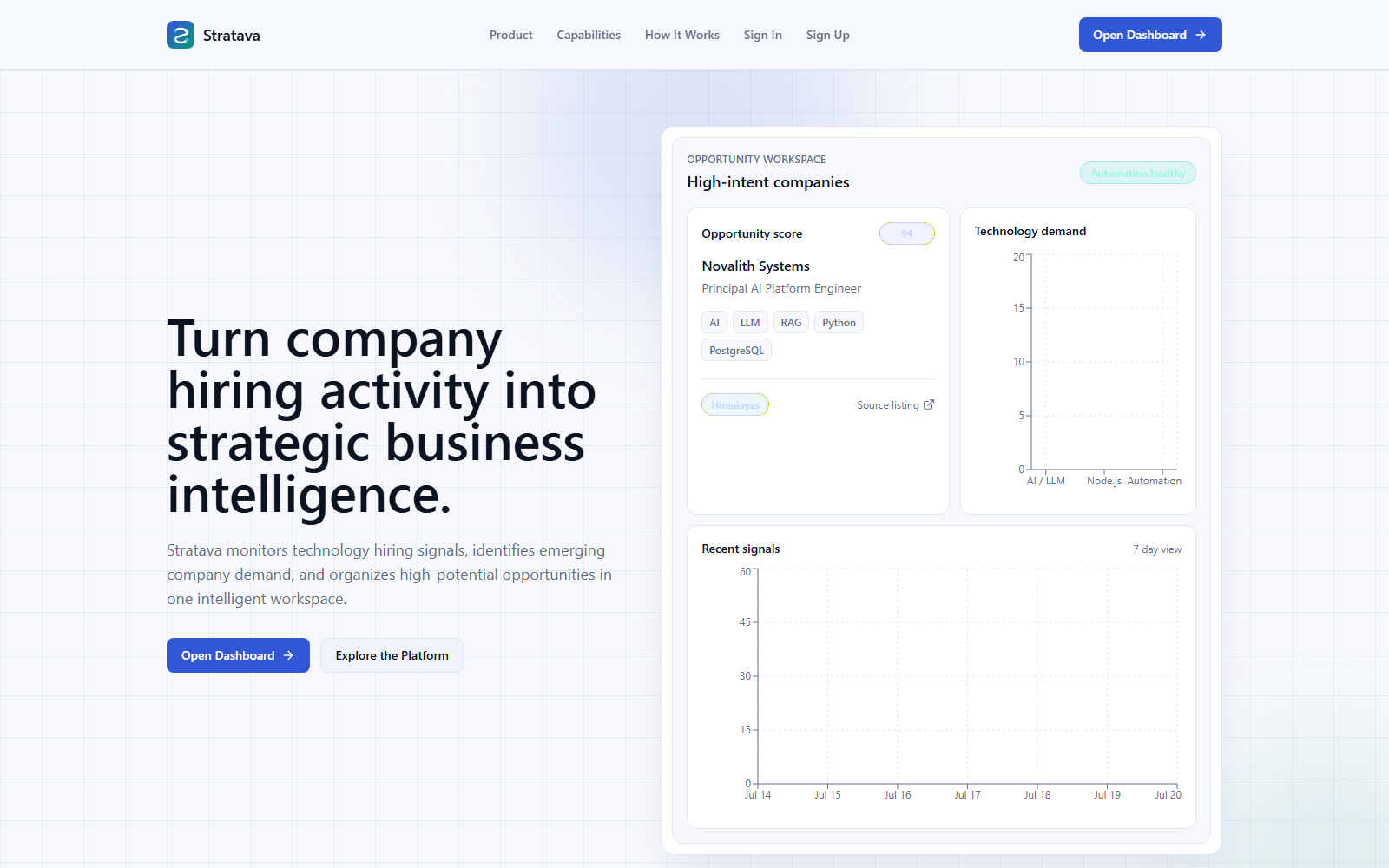
Stratava is an internal AestheTeQs automation project created to explore and demonstrate how modern web applications can interact with Make.com-based workflow orchestration.
The project combines a customer-facing or operational web interface with an external automation layer, allowing application events to trigger structured workflows outside the core application.
Rather than embedding every process directly into application code, Stratava demonstrates an integration-oriented architecture in which selected business events can be handed off to Make.com through webhooks and processed independently.
The implementation also integrates with Supabase, giving the application a persistent cloud data layer while Make.com handles workflow orchestration. Connectivity between the application environment, Make.com webhooks, and Supabase was explicitly tested during development.
The project was developed internally to strengthen practical experience with automation architecture, event-driven workflows, webhooks, cloud data services, and low-code orchestration.
Mechanism
Project Description
The challenge
Many internal business processes involve repetitive actions that do not justify tightly coupling every step to application backend code.
Typical processes may require an application to receive an action, persist information, trigger an automation, process the event through another service, and continue the workflow without requiring a user to manually perform every step.
The engineering challenge was therefore to create an application architecture where the frontend and data layer could work cleanly with an external automation engine.
The solution
Stratava was designed around Make.com as the workflow orchestration layer. Application events can be represented as structured payloads and sent through Make.com webhooks. During development, webhook payloads included identifiers, event types, sources, timestamps, and event-specific data, demonstrating an event-oriented integration pattern.
Supabase provides a cloud-connected data layer while Make.com provides a flexible way to react to application events and coordinate downstream automation.
User / Application Event
          ↓
     Web Application
          ↓
       Supabase
          │
          └──── Event / Webhook
                    ↓
                 Make.com
                    ↓
            Automated Workflow
This provides a practical demonstration of separating core application functionality from workflow automation.
Primary Industry
Business Process Automation / SaaS. The technical patterns demonstrated by Stratava are applicable to areas such as:
Roles
Who the End Users Are
Operations teams
Teams responsible for repetitive operational processes can benefit from workflows that automatically move information between systems.
Sales & business development teams
Webhook-driven automation can support lead events, follow-ups, notifications, and other sales operations.
Internal teams
Stratava demonstrates how AestheTeQs can build internal tools where automation runs behind an application rather than forcing users to operate several disconnected systems manually.
Automation engineers
The project also functions as an internal engineering reference for designing, testing, and troubleshooting Make.com integrations.
Core Features
Make.com Workflow Integration
Application events can trigger Make.com scenarios through webhook-based communication.
Event-Driven Architecture
Structured events allow application actions to be communicated to the automation layer without tightly coupling the two systems.
Supabase Integration
Supabase provides cloud-connected persistence and application data services.
Structured Webhook Payloads
Events can include identifiers, event types, origin information, timestamps, and workflow-specific data.
External Workflow Orchestration
Automation logic can evolve within Make.com without requiring every workflow adjustment to become a frontend application change.
Cloud-Hosted Frontend
The project is publicly demonstrated through Netlify while its integration architecture communicates with external cloud services.
Technologies Used
| Technology | Purpose |
|---|---|
| Make.com | Workflow automation and orchestration |
| Supabase | Cloud data services and persistence |
| Webhooks | Event communication between the application and Make.com |
| REST / HTTP | Integration transport |
| JavaScript / Web Application | User-facing application layer |
| Netlify | Frontend deployment |
The project material confirms both the Make.com webhook endpoint and the Supabase service were part of the integration environment.
Architecture Overview
                  STRATAVA
                     │
                     ▼
              Web Application
                     │
          ┌──────────┴──────────┐
          ▼                     ▼
      Supabase             Event Creation
                                │
                                ▼
                          HTTPS Webhook
                                │
                                ▼
                            Make.com
                                │
                                ▼
                     Automation Scenario
                                │
                                ▼
                       Workflow Actions
The important architectural concept is the separation between the application layer, data layer, and automation layer.
Security & Integration Hardening
The integration uses HTTPS communication between cloud services and keeps automation execution outside the browser-facing workflow.
Webhook endpoints and environment configuration should remain outside publicly exposed source configuration, while validation should be performed before processing external events.
Because this is an internal skills project rather than a regulated production platform, its security is presented as integration hardening and controlled service communication, rather than claiming enterprise security controls that were not part of the project.
Deployment & Infrastructure
The frontend is deployed to Netlify at stratava.netlify.app. The application connects to cloud-hosted services such as Supabase and Make.com rather than requiring the entire automation environment to run on the same server.
Source Code
    ↓
Frontend Build
    ↓
Netlify
    ↓
Stratava Web App
    ↓
Supabase + Make.com
Platform Scale
Stratava demonstrates a reusable automation pattern:
Web application → cloud database → event generation
    → webhook → Make.com workflow → automated downstream action
Its value as an internal project is less about traffic volume and more about demonstrating an integration architecture that can be reused for CRM automation, lead management, notifications, data synchronization, operational workflows, and SaaS products.
Internal R&D. Stratava is an internal engineering project rather than a client deployment. It is documented here for the architecture it demonstrates — separating application, data, and automation layers so workflow logic can evolve independently of the product.